Exploring Multifunctional Rooftops in Mechelen and Brussels
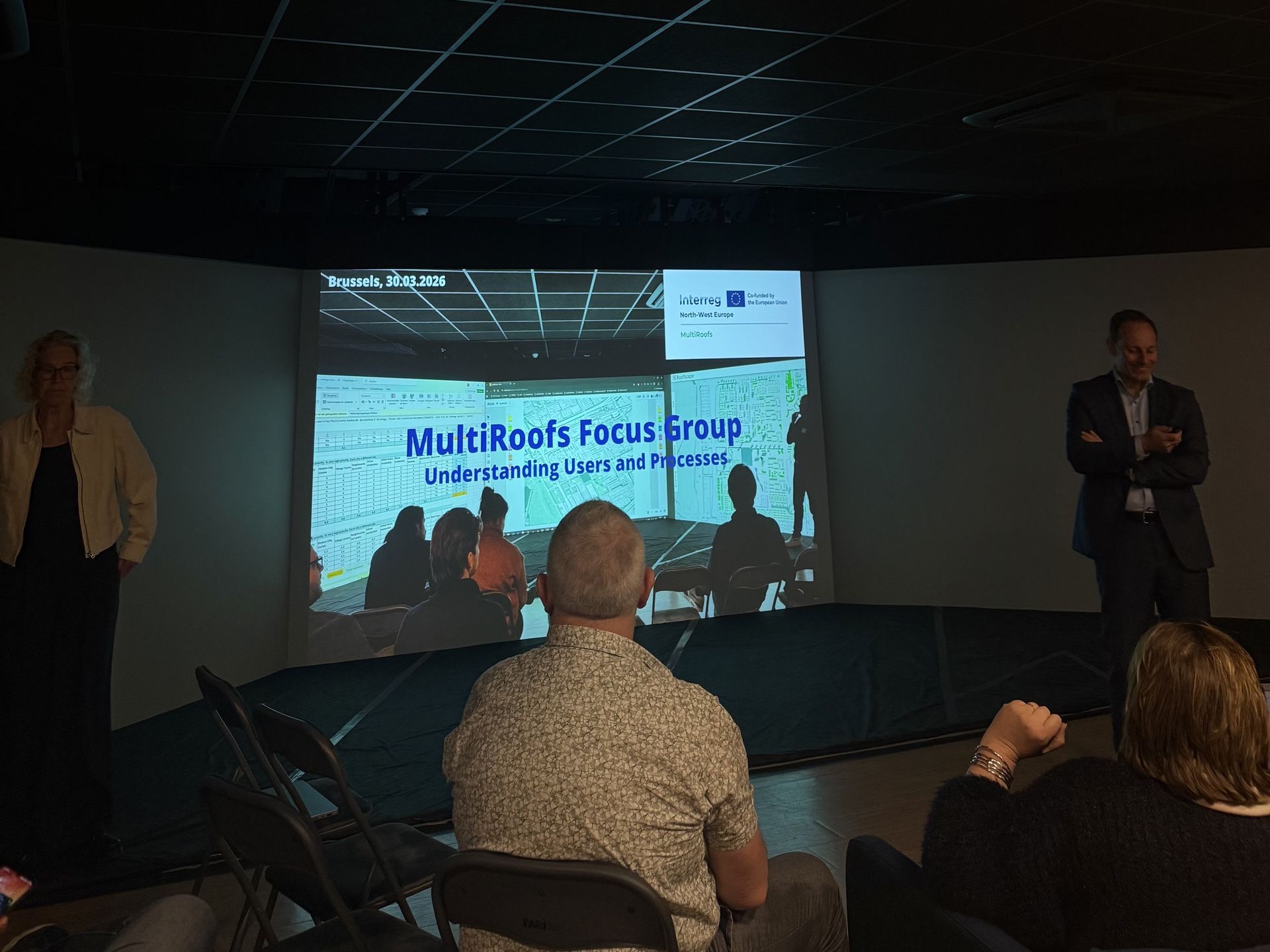
On 30 March 2026, the MultiRoofs consortium organised two focus group workshops at FARI — AI for the Common Good Institute in Brussels, bringing together policymakers, urban planners, architects, climate experts, housing professionals, and rooftop innovators from Belgium and the Netherlands.
The workshops focused on how rooftops can help cities address major urban challenges such as climate adaptation, renewable energy, water management, biodiversity, affordable housing, and social cohesion. The day was divided into two sessions: a morning workshop dedicated to Mechelen and an afternoon workshop focusing on Brussels.
The sessions were introduced by Paul van Roosmalen (City of Rotterdam and initiator of MultiRoofs) and Jan Henk Tigelaar (Rooftop Revolution), who presented Rotterdam as an example of a “rooftop city”, where rooftops are treated as valuable urban space.
Morning Session: Mechelen
The morning workshop explored how the city of Mechelen could use its estimated 5 km² of flat rooftops to address challenges such as climate resilience, energy transition, housing, and public space.
The session began with examples from Rotterdam and Amsterdam, where rooftop projects combine green roofs, water retention, solar panels, biodiversity, and rooftop extensions. These examples demonstrated how rooftop activation can move beyond isolated pilot projects and become part of a broader urban strategy.
The discussion in Mechelen focused mainly on:
- financing and ownership challenges,
- fragmented decision-making in apartment buildings,
interoperability between digital tools,
and the need for more integrated policymaking across departments.
Participants highlighted that rooftop activation is not only a technical challenge, but also a matter of governance, coordination, and cross-sector collaboration. They emphasised that smaller cities require practical and accessible tools capable of translating policy ambitions into operational strategies and concrete actions.
The MultiRoofs project was recognised as a promising approach to visualising trade-offs, supporting prioritisation, and fostering collaboration among diverse stakeholders.
Afternoon Session: Brussels
The afternoon workshop focused on the Brussels-Capital Region, where approximately 35 km² of flat rooftops create significant opportunities, but also considerable complexity. While Rotterdam once again served as an inspiration, participants stressed that Brussels faces very different realities, including:
historic building stock,
strict fire and heritage regulations,
fragmented ownership structures,
and political complexity.
The discussion focused on regulatory barriers, financial feasibility, ownership fragmentation, and the challenge of coordinating many different stakeholders.
Participants also explored more ambitious visions for the future city, including connected rooftop landscapes, rooftop public spaces, and new forms of urban mobility above street level. The MultiRoofs approach was appreciated both as a planning tool and as a conversation starter that can help visualise impacts, support stakeholder dialogue, and challenge outdated systems.
Shared ambitions, different realities
Both workshops highlighted the growing importance of rooftops as multifunctional urban spaces and emphasised the need for integrated, multidisciplinary approaches to rooftop development and governance.
To help frame and structure the discussions, the MultiRoofs framework — Willen – Kunnen – Moeten (Desire – Possibility – Necessity) — was used. This framework enabled participants to approach rooftop activation from three complementary perspectives:
What do we want? the ambitions and societal goals for the city.
What is possible? the technical and spatial feasibility of rooftop interventions.
What is necessary? the urgent urban challenges and policy priorities requiring action.
However, the two sessions reflected different urban realities. In Mechelen, discussions focused more on practical implementation, prioritisation, and feasibility within the context of a smaller and more agile city. Brussels, by contrast, placed greater emphasis on governance complexity, regulatory constraints, and long-term urban transformation.
Despite these differences, both cities identified financing, ownership structures, and stakeholder collaboration as key challenges for successful rooftop activation.
Key takeaways
The MultiRoofs focus groups demonstrated strong interest in using rooftops as a new urban layer capable of supporting climate goals, biodiversity, housing, the energy transition, and social wellbeing.
The discussions showed that rooftop activation requires not only technical innovation, but also strong collaboration, integrated governance, adequate financial support mechanisms, and shared long-term visions for the future city.
The MultiRoofs methodology and tools were recognised as valuable instruments for helping cities translate strategic ambitions into practical implementation.